July 1,2026
Over the past few years, travelling from the UK to Europe has changed significantly. The entry and exit procedures have continued to evolve. If you travel frequently or are planning a holiday, a family visit, or a business trip, you have likely heard about the Entry-Exit System (EES). It represents one of the most significant changes to European border management in decades. For many famous destinations in the Schengen countries, such as Spain, France, Austria, Italy, Greece, and Portugal, a familiar passport stamp will gradually become a thing of the past. Instead, borders will officially record your arrival and departure electronically using a secure digital system. One question that many travellers come up with is. “Will this affect my holiday to Cyprus?” This is a fair doubt because online information has mixed info related to the EU Entry-Exit System Cyprus and European Union rules, and this leads to unnecessary confusion.
Understanding the destination before you travel can save time and help you prepare for the tour confidently. This guide will help you understand the new border system, how it affects UK passport holders, the EU Entry-Exit System Cyprus, and online Cyprus visa UK.
This topic is important to discuss, as it often creates confusion among UK travellers. Well, Cyprus is a member of the European Union, but it is not currently a member of the Schengen Area. This clearly means that the EU Entry-Exit System (EES) does not apply when you enter Cyprus.
Currently, Cyprus is operating its immigration and border control procedures. However, this does not mean that everyone can travel to Cyprus without official permission. British passport holders can visit Cyprus visa-free for a short visit; however, UK residents might have to opt for a Cyprus visa before travelling.
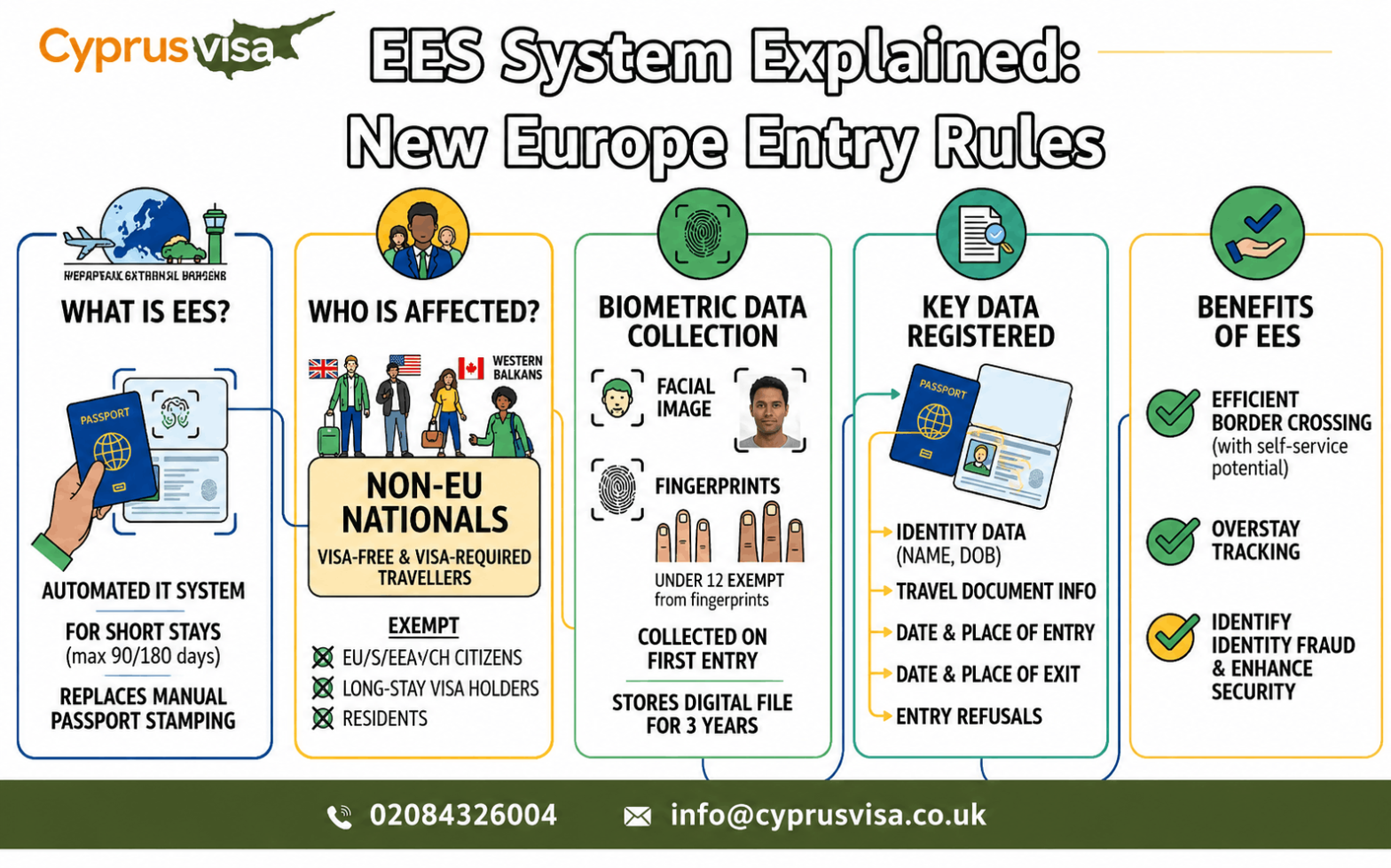
The Entry-Exit System (EES) is a smart, digital border management system introduced by the European Union for travellers who are not citizens of an EU or Schengen country.
Introduced in October 2025, this system will record the entry and exit of travellers in Schengen areas electronically. Now, no manual passport stamping will take place.
EES is introduced to store information, including:
This digital information helps the border authorities in calculating exactly how long visitors remain inside the Schengen Area. This helps in improving the security of the region and reducing the reliance on manual passport stamps.
The Entry-Exit System is designed to modernise the border controls across participating Schengen countries. Another reason is that stamps on the passport can fade away and become difficult to read, and the information can also be misplaced. However, digitally saved data is more reliable and easier to access.
Some major objectives of introducing EES are:
There are chances that first-time registration might take some time, but this will ensure that your future journeys will become smoother once your biometric details are recorded.
This is another major confusion that takes place among travellers. The Entry-Exit System is designed for non-EU nationals travelling to Schengen countries for short stays. For example, if you are travelling to a particular Schengen area, such as France, for a stay of up to 90 days within any 180-day period, your journey is likely to be recorded via EES.
However, if you are travelling to a country that is not a part of the Schengen area, such as Cyprus, then the EU Entry-Exit System Cyprus will not work here, but you still need a visa to travel if you are a non-UK citizen.
NOTE* Although Cyprus is not a part of the Schengen Countries, if you are a non-British passport holder, you might have to apply online Cyprus visa UK. So, make sure to check your eligibility beforehand.
The UK left the European Union in 2020, and since then it has been treated as a third-country nation when travelling to the Schengen area. However, this doesn’t mean that travelling has become difficult. This simply means border rules have changed.
When the Entry-Exit System takes place, you’ll no longer receive a physical passport stamp. Instead of a stamp, the border officials will collect biometric information during first-time registration.
The first-time journey includes:
After the first trip under EES, your subsequent trips will be quicker because your information will already exist within the system.
This is probably the biggest misconception surrounding the new rules.
No, the Entry-Exit System is not a visa. It does not replace a Schengen visa where it is required. EES is simply a digital border registration system that records the entry and exit time and date of the travellers.
Many UK travellers assume that just because Cyprus is a part of the European Union, it follows all Schengen rules by default. This is not the case currently. Cyprus is an EU Member State as it joined the European Union in 2004
…But Cyprus is not yet a part of the Schengen Area
This simply means the EU Entry-Exit System Cyprus does not apply to travellers entering Cyprus directly from the UK or any other country.
The EU Entry-Exit System Cyprus is important, as many UK travellers combine two destinations during one holiday. In this, one destination could be a part of Schengen while another could be Cyprus. For Example:
If your itinerary for 2026 includes an entry into the Schengen Area after leaving Cyprus, the Entry-Exit System will take place while crossing the borders.
NOTE* Knowing the details about the border rules along with the required documents for Cyprus visa will help you avoid unnecessary confusion.
If you are a UK citizen and hold a British Passport, you can travel to Cyprus without a visa for a short stay. However, if you are a UK resident with a non-British passport, you might need to apply online Cyprus visa UK. The process is basic:
NOTE* CYPRUS VISA offers multiple categories of visas for UK travellers. Discuss it with our visa specialists in detail and apply for the one that suits your travel requirements.
| Here’s Our Client’s Experience with Our Visa Experts! I was planning a one-week trip to Germany but wanted to add Cyprus to my travel plan as well. During my research, I became confused about whether Cyprus is a part of the Schengen Area and if it follows the EES rules. Later, I contacted the experts at CYPRUS VISA for guidance. Their team explained everything to me and helped me understand the visa requirements. I got my Cyprus visa appointment London on time and enjoyed an amazing trip to Germany and Cyprus. Thanks to the team of CYPRUS VISA for their support and guidance. I would highly recommend anyone travelling to Schengen countries from the UK to contact the team of professionals and get their visa without any hassle. |
The Entry-Exit System is designed for 29 countries within the Schengen Area. The countries that are part of it are:
| Names of Schengen Countries | ||
| Austria | Belgium | Bulgaria |
| Croatia | Czech Republic | Denmark |
| Estonia | Finland | France |
| Germany | Greece | Hungary |
| Iceland | Italy | Latvia |
| Liechtenstein | Lithuania | Luxembourg |
| Malta | Netherlands | Norway |
| Poland | Portugal | Romania |
| Slovakia | Slovenia | Spain |
| Sweden | Switzerland | – |
The EES framework does not apply to countries like Ireland and Cyprus because they operate separate borders.
If you are travelling from Heathrow to London and receiving a quick passport stamp on arrival, your first Entry-Exit System experience may feel a little different. However, the good news is that this process is designed to make things quicker after your initial registration.
Here’s what you can expect while arriving at the Schengen border:
This is one of the most searched questions, but the answer remains incomplete. While the exact required documents for Cyprus visa vary depending on the purpose of the visit, applicants are commonly asked to provide the following:
There are several myths circulating online related to EES. Some of which are:
European travel continues to evolve, and staying updated and informed is the best way to enjoy a smooth and stress-free journey.
The EU Entry-Exit System Cyprus is a topic that creates confusion because it combines two different frameworks, the Schengen Area and the European Union. However, Cyprus is not a part of the Schengen Area right now, and it follows its own entry procedures.
If you’re travelling from the UK, take a few minutes to check which countries are on your itinerary, then match whether they follow the EES format or whether you need a visa to travel. If a visa is required, check the required documents for Cyprus visa and apply accordingly.
Whether you are planning a ski trip to Austria, a family holiday in Paris, or a business trip to Germany, understanding the latest European border rules helps you travel with great confidence.

British passport holders can usually travel to Cyprus without a visa for short tourist or business visits. However, UK residents with non-British passports may need to apply for online Cyprus visa UK. The exact requirement depends on the nationality and immigration status of the applicant.
The required documents for Cyprus visa generally include:
1. Valid passport
2. Completed visa application form
3. Passport-sized photograph
4. Travel itinerary
5. Accommodation details
6. Travel insurance
7. Fund proof in the account
8. Employment of business proof
No. This confusion always arises among the travellers. The Entry-Exit System is NOT a visa. It is simply an electronic border registration system that records when travellers enter and leave the Schengen area. If your nationality requires a visa for the Schengen country, you just obtain one before travelling. The only task of EES is to manage border records and does not grant permission to enter Europe.
In most participating Schengen countries, manual passport stamping will gradually be replaced by the electronic entry and exit records under the EES. Instead of physical stamps, you travel information will be stored in the digital database securly. However, there is no EU Entry-Exit System Cyprus, therefore, Cyprus will continue to follow their own border procedures, which may still include passport stamps depending on the government and local immigration practices.

Our team will answer all your questions. we ensure a quick response.

Disclaimer: We are a Private Agency Facilitating Clients for the Express Appointments as well as Complete Guidance and We are not affiliated with any Government agencies


© 2026.www.cyprusvisa.co.uk. All Right Reserved

 7300463745


 02084326004


 Your information is safe with us and will not be shared with third
parties.
